User Guide
The TRX File Format
A TRX file is a ZIP archive containing fixed-layout binary arrays:
Entry |
Content |
|---|---|
|
Flat, row-major XYZ triplets in RAS+ space (float16, float32, or float64) |
|
Streamline start indices plus a sentinel equal to the total vertex count |
|
Per-streamline scalar fields |
|
Per-vertex scalar fields |
|
Streamline indices for a named bundle |
|
Per-group scalar metadata |
|
Voxel-to-RAS affine and grid dimensions |
Streamline i occupies vertices offsets[i] through offsets[i+1] - 1
in the positions array. The offset array always ends with a sentinel entry
equal to the total vertex count.
Coordinate Systems
TRX stores positions in RAS+ (right-anterior-superior), the convention used by NIfTI and most neuroimaging software. ITK uses LPS+ (left-posterior-superior).
This difference is something that users will never need to know about. All ITK-facing functions accept and return LPS+ coordinates.
Core Classes
Class |
Role |
|---|---|
|
Central |
|
Incremental streaming writer; fields registered once, then pushed per streamline |
|
|
|
Named bundle; stores streamline indices and DPG fields; lazy subsetting |
|
Assigns streamlines to named groups from one or more NIfTI segmentation atlases |
|
Maps a group’s streamlines onto a reference grid to produce a track density image |
Lazy Loading
When a file is opened through TrxFileReader, positions are not decoded
immediately. The backing handle retains a reference to the memory-mapped ZIP
entry; positions are paged in on the first explicit access.
This means that opening a multi-gigabyte tractogram and immediately issuing an AABB query is fast: only the offset array (a fraction of the total file size) is read to build per-streamline bounding boxes. Position data for streamlines outside the query box is never decoded.
The bounding-box cache is built once on the first QueryAabb() call and
retained for subsequent queries on the same TrxStreamlineData object.
AABB Queries
TrxStreamlineData::QueryAabb() accepts min and max LPS+ corners and
returns a new TrxStreamlineData containing streamlines whose bounding
boxes intersect the query region. An optional overload caps the number of
returned streamlines, which is useful for interactive viewer applications:
itk::TrxStreamlineData::PointType minCorner, maxCorner;
minCorner[0] = -30.0;  minCorner[1] = 5.0;  minCorner[2] = -10.0;
maxCorner[0] =  -5.0;  maxCorner[1] = 25.0; maxCorner[2] =  15.0;

// Uncapped
auto subset = data->QueryAabb(minCorner, maxCorner);

// Capped at 500 streamlines (random sample when over limit)
auto preview = data->QueryAabb(minCorner, maxCorner,
                               /*buildCache=*/false,
                               /*maxStreamlines=*/500,
                               /*rngSeed=*/42);
Working with Groups
Groups are named collections of streamlines, typically corresponding to anatomical bundles or cortical parcellation regions. Group membership is stored as vectors of streamline indices and loaded lazily on first access.
// Enumerate groups
for (const auto & name : data->GetGroupNames())
{
  auto group = data->GetGroup(name);
  std::cout << name << ": "
            << group->GetStreamlineIndices().size()
            << " streamlines\n";
}

// Get streamlines for one group (lazy subset — no position copy)
auto group  = data->GetGroup("CST_left");
auto bundle = group->GetStreamlines(data.GetPointer());
GetGroup() caches results, so repeated calls for the same name are O(1).
GetStreamlines() returns a TrxStreamlineData subset backed by the
same memory-mapped file.
DPS and DPV Fields
Per-streamline (DPS) and per-vertex (DPV) scalar fields are enumerated with
GetDpsFieldNames() / GetDpvFieldNames() and retrieved as float
vectors with GetDpsField() / GetDpvField():
for (const auto & name : data->GetDpsFieldNames())
{
  auto values = data->GetDpsField(name);
  // values.size() == data->GetNumberOfStreamlines()
}

for (const auto & name : data->GetDpvFieldNames())
{
  auto values = data->GetDpvField(name);
  // values.size() == data->GetNumberOfVertices() for scalar fields
}
Multi-column fields are returned flat in row-major order.
Streaming Writer
TrxStreamWriter is designed for pipelines that generate streamlines
incrementally, such as tractography algorithms. Fields must be declared
before the first PushStreamline() call. The writer validates that each
push provides all declared fields with consistent lengths, preventing
misaligned arrays in the output archive.
auto writer = itk::TrxStreamWriter::New();
writer->SetFileName("output.trx");
writer->UseCompressionOn();

// Declare fields first
writer->RegisterDpsField("mean_fa", "float32");
writer->RegisterDpvField("fa",      "float32");

// Push streamlines one at a time
writer->PushStreamline(points,
  /*dps=*/{ { "mean_fa", 0.65 } },
  /*dpv=*/{ { "fa", faPerVertex } });

// Seal the archive
writer->Finalize();
Group membership can also be assigned per streamline by passing a list of
group names to PushStreamline(). Groups are written as TRX
groups/<name>/indices.uint32 entries when Finalize() is called.
Note
Calling Finalize() is required. Omitting it leaves the ZIP archive
in an incomplete state.
Example Results
The following figures demonstrate the module working on a representative HCP subject tractogram parcellated with 4S456 and Glasser atlases.
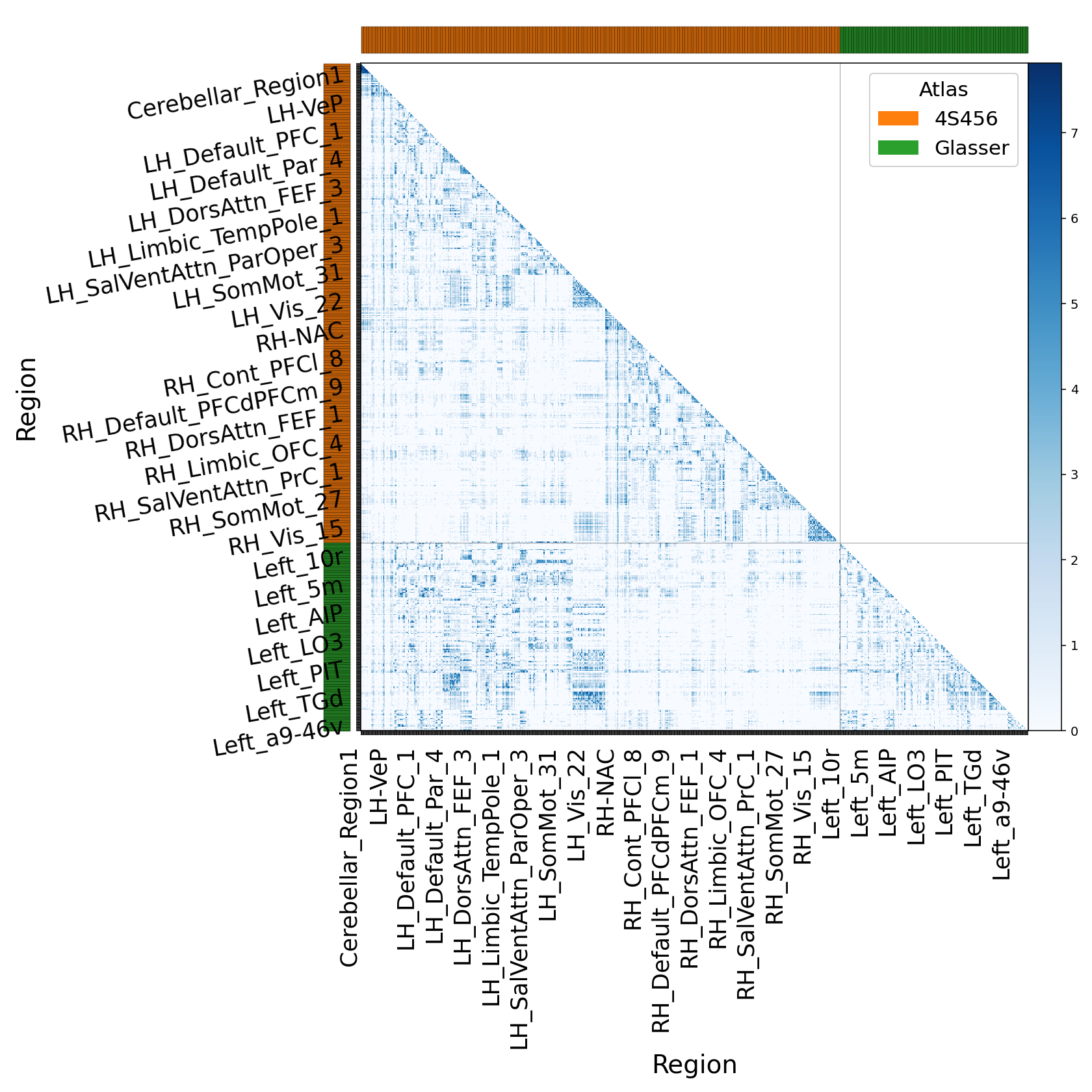
Log-scaled connectivity matrix computed from ComputeGroupConnectivity()
after parcellation. Rows and columns are grouped by atlas; the highlighted
cell marks the strongest off-diagonal group pair.
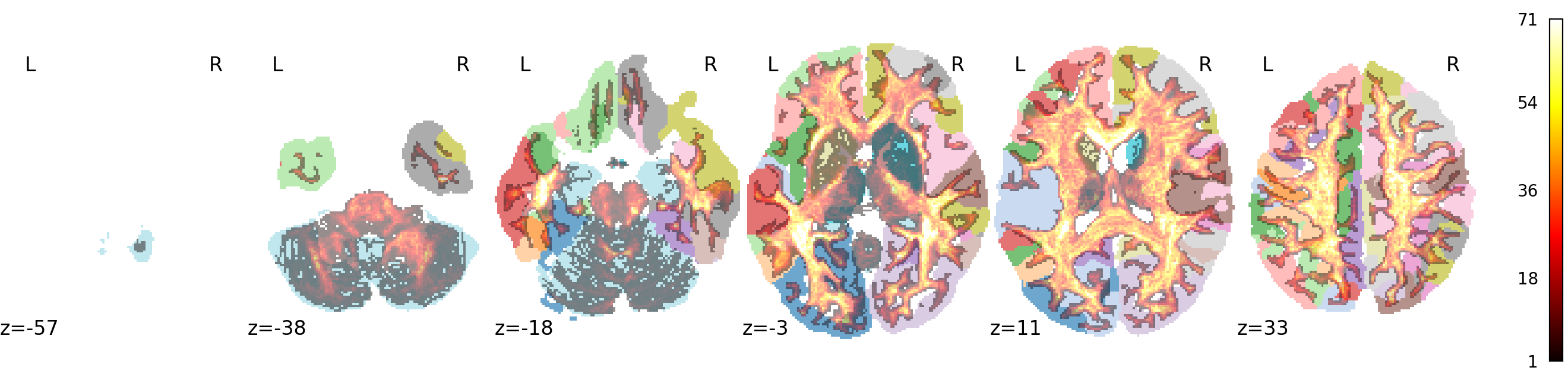
Whole-brain track density image (hot colormap, semi-transparent) overlaid on the 4S456 atlas. A quick quality-control check that tract density follows plausible white-matter anatomy and is aligned to parcel boundaries.
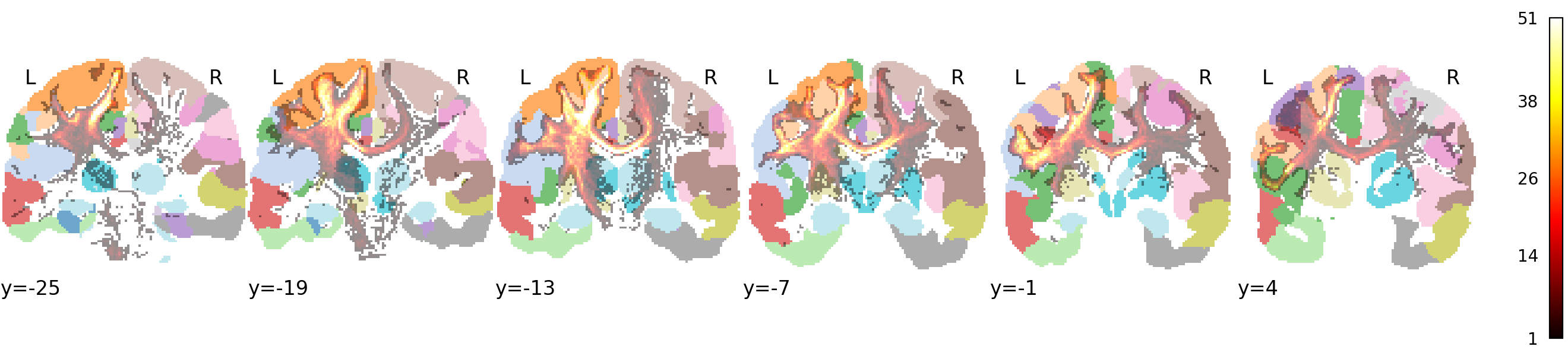
Coronal bundle TDI for streamlines intersecting Glasser_Left_4 and
Glasser_Left_6*, showing expected corticospinal projections and
verifying local atlas–streamline alignment.
Applying Transforms
TrxStreamlineData provides template methods for applying ITK transforms
in place or streaming the result to a writer. The chunked variants process
streamlines in batches to keep memory use bounded:
// Apply transform in place (all positions decoded into memory)
data->TransformInPlace(transform.GetPointer());

// Stream transformed positions directly to a writer (memory-efficient)
data->TransformToWriterChunked(transform.GetPointer(), writer.GetPointer());
The vnl_matrix buffer overload avoids repeated allocation when processing
many streamlines:
vnl_matrix<double> buffer;
data->TransformToWriterChunkedReuseVnlBuffer(
    transform.GetPointer(), writer.GetPointer(), buffer);